Every family reaches a point where they start questioning whether their health insurance is actually working for them. The premiums go up, the deductibles never seem to get met, and when someone finally needs to see the doctor, the appointment is two weeks out. It is a frustrating cycle that many New Jersey families know all too well.
At Jersey Family Health in Princeton, NJ, Dr. Salman Saad, MD and Dr. Moizah Saad, DO built their practice specifically around this problem. They offer both traditional insurance-based primary care and a Direct Primary Care (DPC) membership model, giving families a real choice instead of a one-size-fits-all approach. If you have been wondering whether DPC or traditional insurance is the better fit for your household, this guide breaks down exactly what each model offers, where each one falls short, and how to decide which one makes more sense for your family’s health and budget.
What Is Traditional Health Insurance and How Does It Work for Families?
Traditional health insurance works by spreading financial risk across a large pool of policyholders. You pay a monthly premium, and in return, your insurer agrees to cover a portion of your medical costs once you meet your deductible. For families, that typically means navigating in-network vs. out-of-network rules, copays, coinsurance, prior authorizations, and an annual deductible that can easily run into the thousands before coverage meaningfully kicks in.
The structure of traditional insurance was designed around catastrophic events, not routine primary care. It works reasonably well when a family member needs surgery, is hospitalized, or requires specialist intervention. For the everyday reality of family medicine, though, including sick visits, annual physical exams, chronic disease management, and pediatric care, the traditional insurance model often creates as many barriers as it removes.
Physicians practicing in a traditional insurance-based system are typically required to see 20 to 30 patients per day to maintain financial viability. That volume translates into the 10 to 15-minute appointments most families are familiar with, rushed conversations, and a physician who may be excellent but simply does not have the time to know any patient well. Referrals require prior authorizations. Lab results come back without explanation. And if your child develops a fever on a Friday afternoon, you may end up in urgent care simply because your pediatrician could not fit you in.
None of this is the fault of individual physicians. It is the natural result of a system that pays doctors based on how many patients they see, not how well they know them.
What Is Direct Primary Care and How Is It Different?
Direct Primary Care removes insurance from the equation entirely at the primary care level. Instead of billing through an insurer for every visit, patients pay a flat monthly membership fee directly to their physician. That fee covers unlimited primary care visits, same-day scheduling, extended appointment times, and direct 24/7 access to your doctor by phone, text, or email.
DPC is not health insurance and it does not replace it. What it does replace is the role insurance plays in your everyday, routine healthcare. Most DPC members pair their membership with a lower-premium, high-deductible or catastrophic plan for hospital stays, specialist procedures, and major medical events. The combination often costs less overall than a comprehensive family insurance plan, while delivering dramatically better access to primary care.
The DPC model keeps patient panels small intentionally. Rather than managing 2,000 or more patients, a DPC physician may carry a panel of 400 to 600. That difference is what makes relationship-based care genuinely possible. Your doctor knows your family. They remember conversations from your last visit. They have enough time at every appointment to actually work through what is going on.
At Jersey Family Health, DPC membership pricing is structured to be accessible for families of varying sizes, with transparent monthly rates based on age groups and no hidden fees or per-visit charges for covered services.
DPC vs Insurance: A Side-by-Side Comparison for Families
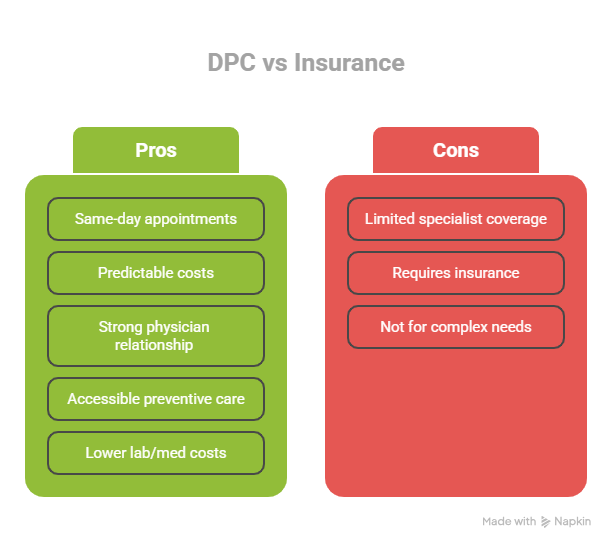
Understanding the differences between DPC and traditional insurance is easier when you look at how they perform across the things families actually care about.
Access and Wait Times
Under a traditional insurance model, getting a same-day appointment with your primary care physician is the exception, not the rule. Most families wait days to weeks for non-urgent visits, and even urgent sick visits often result in a detour to an urgent care center. DPC flips this entirely. Jersey Family Health offers same-day appointments for DPC members when available, along with extended visit times of 30 minutes or more. For a parent trying to figure out whether their child’s ear infection warrants an antibiotic, or whether a teenager’s sports injury needs imaging, that access matters enormously.
Cost Predictability
One of the most common complaints about traditional insurance is the unpredictability of out-of-pocket costs. Copays, coinsurance, surprise bills for out-of-network services, and a deductible that resets every January create a financial environment that is genuinely difficult to plan around. DPC replaces all of that at the primary care level with a single monthly fee. Jersey Family Health members know exactly what their primary care costs every month, and they never receive a surprise bill for covered services.
Quality of the Physician Relationship
In a traditional insurance practice, continuity of care is often aspirational rather than real. Patients may see different providers at each visit, and even when they do see the same physician, the 15-minute time slot does not leave room for the kind of conversation that builds genuine understanding of a patient’s health history, lifestyle, and concerns. DPC members at Jersey Family Health see either Dr. Salman Saad or Dr. Moizah Saad at every visit. Both physicians know their patients before they walk in the door, and both bring the depth that comes from genuinely small patient panels.
Preventive Care
Traditional insurance covers many preventive services at no cost under the Affordable Care Act, including annual wellness exams, cancer screenings, and immunizations. This is a genuine strength of the insurance model. However, the coverage of preventive services does not address the access problem. If you cannot get a timely appointment, the benefit is theoretical. DPC ensures that preventive care is not just covered but also actually accessible, and that your physician has enough time to review your wellness labs, discuss your results thoroughly, and build a proactive plan with you.
Lab and Medication Costs
This is where DPC creates significant savings for many families. Because DPC practices operate outside of insurance billing, they can offer lab tests at wholesale pricing that is substantially lower than what most insured patients pay. Many DPC practices also offer discounted generic medications directly through the practice. For families managing a chronic condition, the cumulative savings on labs and prescriptions can be considerable.
Specialist Care and Hospitalizations
This is where traditional insurance holds a clear advantage. DPC membership covers primary care only. For specialist consultations, hospital admissions, surgery, advanced imaging, and emergency care, you need insurance coverage. This is precisely why most DPC members do not abandon insurance entirely. They use a lower-cost plan for the big events and DPC for everything else. If your family has complex specialist needs or a member who requires frequent hospitalizations, your insurance plan selection matters significantly alongside whatever primary care model you choose.
How DPC Serves Families With Specific Health Needs
One of the clearest advantages of DPC for families is how well it works when health needs are ongoing rather than episodic.
Families Managing Chronic Conditions
If a parent is managing hypertension, diabetes, asthma, or heart disease, the traditional insurance model creates friction at every step. Follow-up visits have copays, lab monitoring adds up, and getting a quick question answered often requires scheduling a formal appointment. Under DPC, chronic disease management becomes genuinely continuous. Follow-up visits are included, your physician proactively tracks your numbers, and you can reach out directly when something changes without worrying about the cost of a visit.
Women’s Health Across Life Stages
Women’s healthcare needs evolve significantly across different life stages, and the DPC model supports that continuity in a way that fee-for-service insurance often does not. At Jersey Family Health, Dr. Moizah Saad is particularly experienced in women’s health, including hormone therapy certified through the Heather Hirsch Academy, menopause management, HPV screenings, pap smear tests, and breast health screening. Having a physician who knows your history and has time to discuss nuanced decisions about hormone management or perimenopause symptoms is genuinely different from a rushed insurance-based visit.
Men’s Preventive Care
Men are statistically less likely to seek preventive care, and the inconvenience of the traditional insurance model does not help. Long wait times and copays for follow-ups are real deterrents. DPC removes both. At Jersey Family Health, men’s health services include testosterone testing and treatment, prostate health screening, and comprehensive preventive men’s care, all within the same accessible DPC structure.
Children and Teenagers
For families with kids, the DPC model addresses some of the most common parental frustrations. Well-child visits and sports physicals are included in the membership. Sick visits can be scheduled the same day. And when a parent has a concern that does not quite rise to the level of “make an appointment” but still deserves a physician’s input, they can send a quick message directly to Dr. Saad rather than waiting and wondering.
When Traditional Insurance Is the Better Choice
Being balanced about this matters. Traditional insurance is the right primary structure for some families.
If your family has complex specialist needs, such as an oncology patient, a child with significant developmental needs requiring multiple specialist teams, or a family member with a condition requiring frequent hospitalizations, your insurance plan selection is the highest priority decision. DPC will enhance your primary care experience, but it does not address the specialist and hospital-level coverage that your insurance needs to provide.
If your family’s healthcare usage is genuinely minimal, meaning you are young, healthy, and rarely see a doctor beyond an annual physical, a comprehensive insurance plan paired with DPC may feel like duplicate spending. In those cases, a high-deductible plan paired with a health savings account (HSA) might be sufficient without DPC.
If your employer provides a strong fully-funded family health plan at no additional premium cost to you, the financial calculus of adding DPC shifts. The relationship and access benefits of DPC may still be worth it, but the cost savings argument becomes less central.
The most honest answer is that DPC and insurance are not competitors. They solve different problems. The question for most families is not which one to choose but how to combine them wisely.
The Case for a Hybrid Approach
The most practical model for most New Jersey families is a hybrid one: DPC for primary care, paired with a lower-cost insurance plan for everything else.
Here is why this works. The majority of your family’s healthcare interactions are at the primary care level. Sick visits, annual physicals, preventive screenings, follow-ups for chronic conditions, and acute care visits for things like UTIs, ear issues, or minor injuries like lacerations are all primary care territory. DPC covers all of that at a predictable monthly cost, while eliminating the per-visit charges and access barriers that make traditional insurance-based primary care so frustrating.
The insurance plan then becomes what it was always better suited to be: protection against the unexpected. Hospital stays, specialist procedures, advanced imaging, and emergency care are covered, but you are not paying for a comprehensive plan to cover things your DPC membership already handles better and more affordably.
Jersey Family Health is a Direct Primary Care practice by design. Primary care is provided through DPC membership, and the Medicare Patients page has more information for Medicare patients. This means families can make the transition to DPC on their own timeline, with some family members joining before others.
Telemedicine: A Feature That Strengthens Both Models
One component that matters increasingly for New Jersey families is telemedicine access. Jersey Family Health offers telemedicine services in NJ, telemedicine in NY, and telemedicine in CA for DPC members, meaning you can reach your physician via secure virtual visit regardless of where you are across those three states.
This matters for families with members who travel for work, college students who need to maintain continuity with their home physician, or simply for the many situations where a quick telehealth call resolves a concern without requiring anyone to leave work or rearrange a schedule. The telemedicine access included in Jersey Family Health DPC membership is a meaningful advantage over insurance-based telemedicine, which often routes patients to unfamiliar providers with no knowledge of their history.
Mental Health Within the DPC Framework
Mental health is an area where the traditional insurance model struggles significantly. Prior authorizations, limited in-network therapists, and separate deductibles for behavioral health create barriers that cause many families to go without care they clearly need. While DPC membership does not replace dedicated mental health treatment, having a primary care physician who is accessible, knows your family, and is experienced in anxiety and depression management provides meaningful support. Jersey Family Health also offers psychiatric services, and the coordination that comes from a DPC physician who knows your full history can be especially valuable when navigating mental health referrals and treatment planning.
Additional Services Covered Under DPC Membership
Beyond the core primary care services, Jersey Family Health’s DPC membership supports a broader range of health needs that families frequently encounter.
Medical weight loss and counseling is available for adults managing weight-related health conditions. Joint injections and steroid injections for musculoskeletal issues are handled in-office without additional per-procedure fees. Smoking cessation support is available for family members working toward quitting. For older adults in the family, geriatric care is built into the practice’s scope, and for working professionals, executive health services provide the kind of proactive, comprehensive monitoring that busy schedules often push aside.
The patient care coordination that comes with DPC membership also means your physician actively manages specialist referrals, follows up on imaging results, and helps navigate the insurance side of any care that falls outside the DPC scope.
FAQs
Can DPC really save our family money compared to traditional insurance?
For many families, yes, though the math depends on your specific situation. A family on a comprehensive insurance plan pays both premiums and out-of-pocket costs for primary care visits, lab work, and follow-ups. DPC replaces the primary care portion with a predictable monthly fee, often at lower total cost when you factor in eliminated copays, wholesale lab pricing, and reduced urgent care visits. Paired with a lower-premium high-deductible plan for major events, many families find their total healthcare spending decreases while their access improves significantly. Jersey Family Health offers a free initial consultation to help you assess whether DPC makes financial sense for your household.
Does DPC membership cover vaccinations and immunizations for children?
Yes. Preventive immunizations and vaccinations are included as part of pediatric care and well-child visits within the DPC membership. Keeping children current on their vaccine schedule is a core part of the preventive care that DPC is designed to support without creating financial barriers at the point of service.
What happens if a DPC member needs to see a specialist?
DPC membership covers primary care, not specialist consultations. However, your Jersey Family Health physician coordinates specialist referrals, communicates with specialists on your behalf, and follows up on any recommendations. This care coordination is included in your membership, and your specialist visits are then handled through your insurance plan. The advantage of having a DPC physician manage this process is that you have an advocate who knows your complete history and can help ensure the right specialist sees the right information.
Is DPC a good fit for a family where some members are generally healthy and some have ongoing conditions?
This is actually where DPC tends to work exceptionally well. Family membership plans at Jersey Family Health allow you to enroll the whole family under one structure. Healthy family members benefit from the access and preventive care without the friction of insurance barriers, while members managing ongoing conditions benefit from the unlimited follow-up visits, direct physician access, and proactive monitoring that DPC makes possible. The model accommodates different levels of health need within the same family without penalizing anyone for using the care they need.
Can we switch from insurance-based care to DPC without losing continuity?
Yes. Jersey Family Health provides primary care through a Direct Primary Care membership. If you are already a patient, moving to a DPC membership does not require changing providers or rebuilding a medical relationship from scratch. Your history stays with the practice, and your physician relationship continues without interruption. The DPC membership page and FAQ section on the Jersey Family Health website walk through the enrollment process in detail.
Conclusion
The choice between DPC and traditional insurance is not really an either/or decision for most families. Traditional insurance provides essential protection for hospital-level care and specialist needs, and that coverage should not be dropped. What DPC changes is the primary care experience, replacing rushed appointments, access barriers, and unpredictable costs with a physician relationship that actually functions the way most families wish healthcare worked.
For families in Princeton and the surrounding Mercer County area, Jersey Family Health offers a practical path to making that shift. With transparent DPC pricing, a membership model built around the physician relationship, and two experienced board-certified physicians, the practice makes it straightforward to explore whether DPC is the right fit. A free initial consultation is available, and the contact page is the easiest place to start.
Medical Disclaimer:
The information provided in this article is intended for general informational purposes only and does not constitute medical advice, diagnosis, or treatment recommendations. Direct Primary Care membership and traditional health insurance serve different functions, and the right approach for your family depends on your individual health needs, financial situation, and coverage requirements. Consult with a licensed healthcare provider before making decisions about your healthcare coverage or treatment. Jersey Family Health physicians are available to discuss your specific situation during a consultation.